Will Pressure Washing Damage My Roof, Plants, or Paint?
It’s a fair concern, and one that every homeowner in Orlando, Winter Park, Apopka, or Lake Mary should think through before hiring any exterior cleaning company. Pressure washing done incorrectly absolutely can damage your roof, strip your paint, harm your landscaping, and erode your stucco. The operative word is incorrectly.
Done right — with the correct pressure settings, appropriate cleaning solutions, proper technique, and the knowledge of when to use soft washing instead of pressure washing — exterior cleaning poses no risk to your home or landscaping. The challenge is that “done right” requires both expertise and the right equipment, which is why this question comes up so often after homeowners experience or witness DIY pressure washing mistakes.
This guide addresses each of the most common damage concerns directly and honestly.
The Truth About Pressure Washing Your Roof
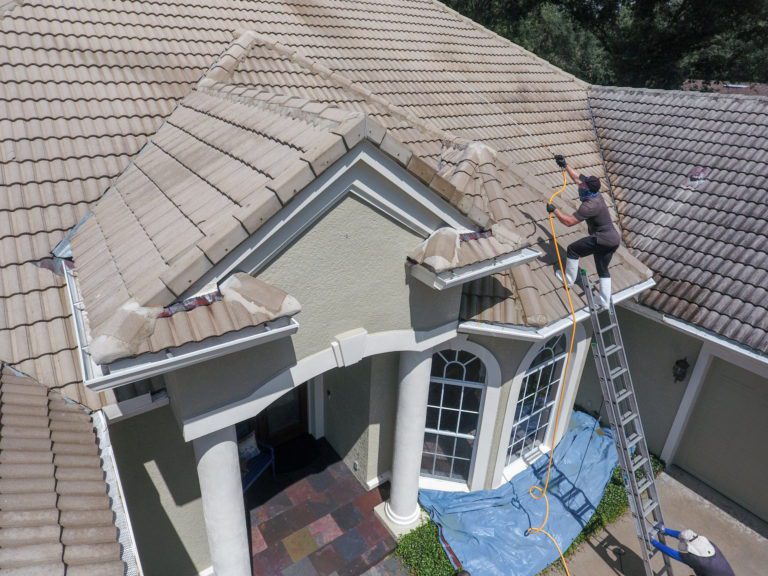
Yes — high-pressure washing will damage your roof. This is not hypothetical. Here’s what actually happens:
Asphalt shingles: Shingles are coated with granules — small mineral particles embedded in the asphalt surface — that protect the underlying material from UV exposure, reflect heat, and provide fire resistance. High-pressure washing blasts these granules off the shingle surface. You can visually see the damage in the water runoff, which turns dark with displaced granules. Once granules are lost, the shingle’s life expectancy drops sharply. Many roofing manufacturers explicitly state in their warranty terms that high-pressure washing voids the warranty.
Clay and concrete tiles: These are brittle and can crack under high-pressure spray, particularly on older installations or tiles that have experienced any previous thermal stress. The grout and mortar between tiles is also vulnerable to erosion from sustained pressure.
Metal roofing: While more durable than shingles, metal roofing can have its coatings stripped by sustained high pressure and can experience denting or deformation from direct high-PSI impact at close range.
The solution — and the only appropriate method for roof cleaning — is roof soft washing. Soft washing uses pressure under 100 PSI (comparable to a garden hose) combined with professionally formulated cleaning solutions that kill and remove biological growth — algae, mold, mildew, lichen, and moss — without any mechanical damage to roofing materials. The result is a thoroughly cleaned roof with zero damage risk and results that last two to three years or longer.
Any company that quotes you for “pressure washing your roof” does not understand safe roof cleaning. Walk away.
Protecting Your Landscaping During a Pressure Wash
The concern about plants is legitimate — but it’s one that a professional company addresses through process, not just product.
Pre-wetting plants: Before any cleaning solution is applied to exterior surfaces near landscaping, surrounding plants, grass, and garden beds should be thoroughly pre-wetted with clean water. Saturated plant tissues absorb less chemical solution, significantly reducing the uptake of any runoff.
Diluting runoff: During the cleaning process, professional crews manage the direction of runoff to minimize concentration near plant root zones. Post-cleaning, all adjacent landscaping is thoroughly rinsed with clean water to dilute any residual solution that may have contacted plant surfaces.
Product matters enormously: Harsh, high-concentration bleach applied without dilution will harm plants — period. JBC Pressure Washings uses Enviro Bio Cleaner, a professional-grade, biodegradable cleaning solution that is specifically formulated to be safe for surrounding vegetation and Florida’s sensitive waterways. It breaks down naturally without leaving persistent chemical residues in soil.
This combination — pre-wetting, managed runoff, post-rinse, and plant-safe chemistry — means that a properly executed professional cleaning poses no meaningful risk to established landscaping. The same cannot be said for DIY approaches using raw bleach or undiluted cleaning concentrates.
What Happens to Paint Under High Pressure
Paint is one of the surfaces most likely to be damaged by incorrect pressure washing — and the outcome depends heavily on the age of the paint, the type of surface it’s applied to, and the technique used.
Old or deteriorating paint: Paint that has already begun to fail — visible as chalking, cracking, peeling edges, or bubbling — has compromised adhesion to the underlying surface. High-pressure washing will strip this paint in sheets. While this is sometimes intentional (power washing before repainting is a legitimate preparation technique), it’s catastrophic if it happens to paint you weren’t planning to replace.
New or well-adhered paint: Sound, properly applied exterior paint on a suitable surface can generally tolerate moderate pressure washing — but the technique matters. Spray angles that direct pressure behind siding joints or window frames force water into areas that should stay dry, causing moisture damage to substrate materials and eventually paint failure from underneath.
Signs that your paint is vulnerable:
- Visible chalking when you run your hand along the surface
- Hairline cracking or alligatoring (a scaled, cracked pattern)
- Paint that sounds hollow when tapped
- Visible peeling or bubbling at edges
- Paint that’s more than 8–10 years old without touch-ups
If any of these conditions exist, tell your exterior cleaning company before work begins. A professional will adjust pressure settings, use a wider spray angle, and maintain greater stand-off distance to protect vulnerable paint — or may recommend soft washing the painted surface entirely.
Stucco: The Surface Most at Risk from Improper Pressure
Stucco is the dominant exterior finish on homes throughout Central Florida, and it is the surface where improper pressure washing causes the most frequent and most expensive damage.
Here’s why stucco is particularly vulnerable: it is a porous, relatively soft material that is applied in layers. The outer layer — the finish coat — is what you see and what gives stucco its texture. Excessive pressure erodes this finish coat, creating pitting, etching, and surface roughness that cannot be sanded smooth. Damaged finish coat must be patched — and patches are almost always visually apparent because the texture rarely matches exactly.
Stucco is also susceptible to water intrusion around cracks or compromised areas. High-pressure water forced into micro-cracks in the stucco surface drives moisture into the wall system behind the stucco, potentially reaching the moisture barrier, framing, and interior wall surfaces. The resulting damage — rot, mold, insulation degradation — can be dramatically more expensive to repair than the stucco itself.
The appropriate cleaning approach for stucco is soft washing: low pressure with cleaning solution that removes biological growth and surface buildup without mechanically eroding the finish. Professional soft washing of stucco requires both the right equipment and experience with the material’s specific vulnerabilities.
How Professional Soft Washing Protects Everything
Soft washing isn’t just a gentler version of pressure washing — it’s a fundamentally different approach to exterior cleaning that prioritizes chemistry over mechanical force. Instead of using water pressure to physically remove dirt and growth, soft washing uses professionally formulated cleaning solutions to kill and dissolve biological material at the molecular level, then rinses it away at low pressure that doesn’t stress any surface.
This approach is superior for several specific reasons:
- It kills the biology, not just removes the visible growth. High pressure removes what’s visible but leaves behind root structures, spores, and embedded organisms. Soft wash chemistry eliminates organisms at the biological level, resulting in results that last significantly longer.
- It’s safe on every surface. The same system — adjusted for appropriate chemical concentration — is safe on asphalt shingles, stucco, vinyl siding, painted wood, and even screen mesh. One method, appropriate for all.
- It protects surrounding landscaping. With plant-safe chemistry like Enviro Bio Cleaner, there’s no trade-off between effective cleaning and protecting your yard.
- It can be applied from ground level. Professional soft wash systems can reach roof surfaces from the ground using appropriate nozzles and delivery pressure — eliminating the ladder work and physical roof access that creates fall risk.
Explore our full range of exterior cleaning services to see how soft washing and targeted pressure washing work together to safely clean every surface on your home.
Frequently Asked Questions
Q: Will pressure washing remove my roof’s protective granules?
A: Yes — high-pressure washing absolutely strips granules from asphalt shingles. This is one of the primary reasons roofs should never be pressure washed. Soft washing with low pressure and appropriate cleaning solutions removes biological growth without touching the granule layer.
Q: Is bleach safe to use near my Florida garden and landscaping?
A: Raw bleach at high concentrations is harmful to plants, particularly direct application to foliage and soil around root zones. Properly diluted solutions applied by trained professionals with pre-wetting and post-rinse protocols minimize risk significantly. JBC uses biodegradable Enviro Bio Cleaner, which is specifically formulated to be safe around established vegetation.
Q: Can a pressure washer strip paint from my stucco?
A: Yes, if applied at too high a PSI or too close to the surface. Stucco with painted finishes is particularly vulnerable. Professional soft washing is the appropriate method for painted stucco — it removes surface buildup without the pressure that can strip or undermine paint adhesion.
Q: My neighbor’s pressure washing company left white streaks on their stucco. What happened?
A: White streaking on stucco after cleaning typically indicates one of two things: either the surface was etched (the outer layer physically eroded, exposing lighter-colored material beneath), or cleaning solution was not fully rinsed and dried on the surface. Both are avoidable with proper technique. Etching unfortunately cannot be undone without patching.
Q: How do I know if a pressure washing company is using the right pressure for my roof?
A: Ask directly. A qualified company should tell you they use soft washing for roofs — meaning pressure under 100 PSI with biocidal cleaning solutions. If they say they pressure wash roofs, or if they can’t explain their roof cleaning method, do not hire them for roof work.
Q: How long should I keep my pets and children off the cleaned area after soft washing?
A: With biodegradable, plant-safe solutions like Enviro Bio Cleaner, surfaces are typically safe for pets and children once they are dry — usually within a few hours depending on sun exposure. Your cleaning crew should be able to provide specific guidance based on the products used.
Ready for a Spotless Property in Orlando?
JBC Pressure Washings serves all of Central Florida. Licensed, insured, and backed by our 5-year warranty.